
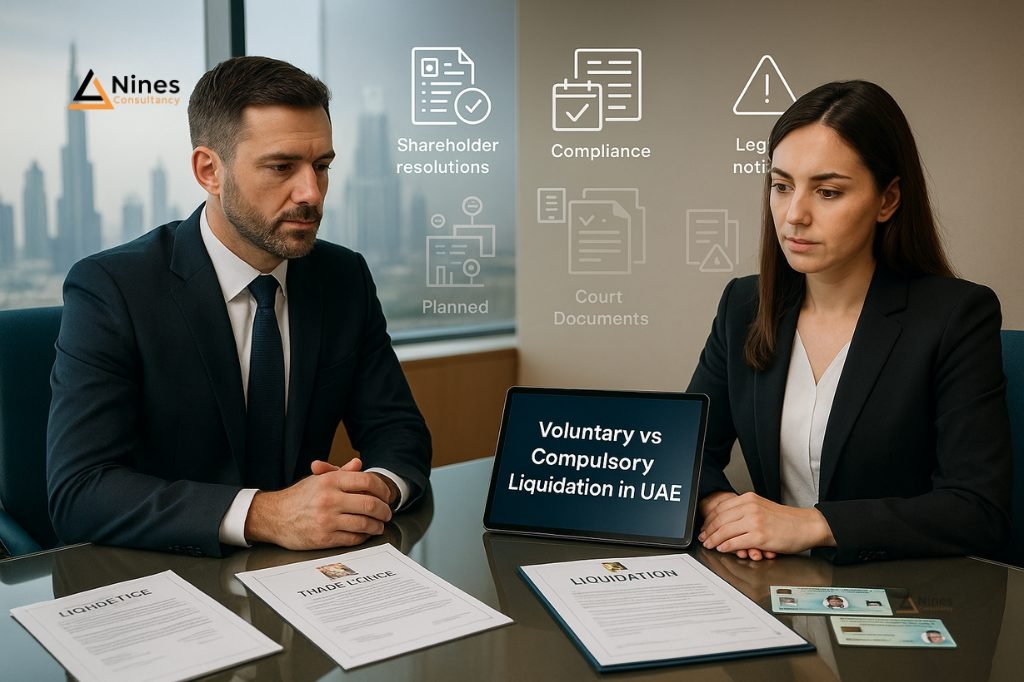
Voluntary vs Compulsory Liquidation in UAE
A Practical Guide for Business Owners
Closing a company in the UAE is not simply about stopping operations or cancelling a trade license. It is a regulated legal process governed by federal laws, emirate-level authorities, and multiple government departments. Choosing the wrong liquidation route can lead to penalties, visa issues, banking problems, and long-term compliance risks.
This is where the confusion usually starts for business owners. Should you opt for voluntary liquidation, or are you facing compulsory liquidation? What is the difference, who decides, and how does it affect shareholders, directors, visas, and liabilities?
In the UAE, liquidation is not a one-size-fits-all process. The approach depends on why the business is closing, its financial position, creditor exposure, and regulatory status with authorities such as the Department of Economic Development (DED), Free Zone Authorities, the Federal Tax Authority (FTA), MOHRE, and immigration departments.
Many businesses delay liquidation thinking they can “pause” operations. In reality, delayed action often increases costs and risks. Trade license renewals continue, visas remain active, VAT obligations stay open, and penalties can quietly accumulate.
This guide explains voluntary vs compulsory liquidation in the UAE in a clear, practical, and business focused way. Whether you operate in Dubai, Abu Dhabi, Sharjah, Ajman, or any UAE Free Zone, this article will help you understand:
• Which type of liquidation applies to your situation
• The step by step process under UAE law
• Cost, timeline, and documentation expectations
• Common mistakes businesses make during closure
• How professional liquidation support protects you legally and financially
If you are considering company closure or have already received a legal notice, understanding the difference between voluntary and compulsory liquidation is critical before taking your next step.
What Is Company Liquidation in the UAE?
Company liquidation in the UAE is the formal legal process of closing a business, settling liabilities, cancelling registrations, and removing the company from official records.
Liquidation applies to:
• Mainland companies registered with DED
• Free Zone companies
• Offshore entities
• Branch offices and representative offices
The process ensures:
• All debts are settled or legally addressed
• Employees and visas are cancelled correctly
• VAT and corporate tax obligations are closed
• Bank accounts are formally closed
• Authorities issue a final clearance
Without proper liquidation, a company continues to exist legally even if it has stopped operating.
Voluntary Liquidation in UAE Explained
What Is Voluntary Liquidation?
Voluntary liquidation occurs when company owners or shareholders choose to close the business willingly. It is a planned, controlled process initiated before the company is forced into closure.
This is the most common and recommended route when a business:
• Is no longer profitable
• Has completed its purpose
• Is restructuring or relocating
• Wants to avoid future liabilities
Voluntary liquidation can apply to solvent and insolvent companies, depending on how liabilities are handled.
Types of Voluntary Liquidation in UAE
1. Solvent Voluntary Liquidation
The company can pay all its debts and obligations.
Common scenarios include:
• Business closure after project completion
• Group restructuring
• Strategic exit from UAE market
2. Insolvent Voluntary Liquidation
The company cannot fully pay its debts but initiates closure before court action.
This approach allows better control and often limits personal exposure for shareholders.
Step by Step Voluntary Liquidation Process in UAE
Step 1: Shareholder Resolution
• Board or shareholders pass a resolution to liquidate
• Liquidator appointment is approved
• Resolution is notarized (mainland) or attested (free zone)
Step 2: Liquidator Appointment
• Licensed liquidator is appointed
• Liquidator takes control of company closure process
Step 3: Public Notice
• Liquidation notice published in local newspapers
• Mandatory notice period usually 45 days
Step 4: Clearance from Authorities
• DED or Free Zone Authority
• MOHRE and Immigration
• FTA for VAT deregistration
• Customs (if applicable)
Step 5: Bank Account Closure
• Final account settlement
• Clearance letters obtained
Step 6: License Cancellation
• Trade license cancelled
• Company officially deregistered
For structured guidance, many businesses rely on professional company liquidation services in UAE to avoid compliance gaps.
Compulsory Liquidation in UAE Explained
What Is Compulsory Liquidation?
Compulsory liquidation occurs when a company is forced to close by legal or regulatory authorities, usually through a court order.
This type of liquidation is not voluntary and typically arises due to:
• Failure to pay creditors
• Court judgments
• Regulatory violations
• Long term non compliance
Compulsory liquidation is more complex, public, and risky than voluntary liquidation.
Common Reasons for Compulsory Liquidation in UAE
• Non payment of debts
• Bounced cheques leading to court cases
• Failure to renew trade license repeatedly
• VAT non compliance and penalties
• Employee disputes escalated legally
• Fraud or serious regulatory breaches
Once compulsory liquidation begins, control shifts from shareholders to the court appointed liquidator.
Step by Step Compulsory Liquidation Process
Step 1: Legal Petition
• Creditor, authority, or stakeholder files case
• Court reviews evidence
Step 2: Court Order Issued
• Court orders liquidation
• Appoints official liquidator
Step 3: Asset Review and Seizure
• Company assets assessed
• Accounts may be frozen
Step 4: Debt Settlement
• Creditors prioritized by law
• Limited control for shareholders
Step 5: Final Deregistration
• Company removed from registry
• Directors may face restrictions
This process is lengthy and can damage personal and professional credibility if not handled early.
Voluntary vs Compulsory Liquidation in UAE: Key Differences
Control and Decision-Making
• Voluntary liquidation allows owner control
• Compulsory liquidation removes owner authority
Cost and Risk
• Voluntary liquidation is predictable and structured
• Compulsory liquidation involves legal fees, court costs, and penalties
Reputation and Records
• Voluntary closure preserves business reputation
• Compulsory liquidation creates legal records
Timeline
• Voluntary liquidation is faster
• Compulsory liquidation can take months or years
Why Liquidation Choice Matters in UAE Context
In the UAE, company compliance is closely connected across systems. DED, Free Zones, FTA, banks, and immigration departments share data. An unresolved closure in one area often blocks processes in another.
For example:
• Unclosed VAT registration prevents license cancellation
• Active visas block final clearance
• Bank accounts cannot close without liquidation documents
Choosing voluntary liquidation early helps businesses avoid forced action by authorities.
Cost, Timeline, and Documents for Liquidation in UAE
Estimated Cost Range
• Voluntary liquidation typically starts from AED 5,000 onward
• Compulsory liquidation costs vary significantly
Note: These are general indicative ranges. Actual costs depend on company structure, emirate, liabilities, and approvals required.
Typical Timeline
• Voluntary liquidation: 30 to 60 days
• Compulsory liquidation: Several months or longer
Key Documents Required
• Trade license
• MOA or AOA
• Shareholder resolutions
• Liquidator appointment letter
• VAT and tax clearance
• Bank closure letters
Why Choose Nines Consultancy for Company Liquidation?
At Nines Consultancy, we do not treat liquidation as a paperwork exercise. We manage it as a risk-mitigation and compliance strategy.
What Sets Us Apart
• Deep UAE regulatory knowledge
• Mainland and Free Zone expertise
• Licensed liquidator coordination
• VAT and tax closure support
• End to end clearance handling
Whether you need company liquidation in Dubai, Sharjah, Ajman, or other emirates, we ensure the process is legally clean and future-safe.
Call us: +971529757543
WhatsApp: +971529757543
Frequently Asked Questions (FAQ)
Is voluntary liquidation better than compulsory liquidation in UAE?
Yes. Voluntary liquidation offers control, lower risk, and faster closure compared to compulsory liquidation initiated by courts.
Can I liquidate a company with outstanding debts?
Yes, but the process and approach depend on whether liquidation is voluntary or compulsory. Professional assessment is critical.
How long does company liquidation take in UAE?
Voluntary liquidation usually takes 30 to 60 days. Compulsory liquidation can take much longer.
Do I need to cancel visas before liquidation?
Yes. Employee and investor visas must be cancelled before final license cancellation.
Is VAT deregistration mandatory during liquidation?
Yes. VAT deregistration with FTA is mandatory if the company is VAT registered.
Choose the Right Exit Strategy
Company liquidation in the UAE is not about closing doors. It is about closing them correctly.
Voluntary liquidation gives you clarity, control, and protection. Compulsory liquidation is often the result of delay or inaction. The earlier you seek professional guidance, the more options you retain.
If you are unsure which path applies to your business, speak to experts before taking action.
Book a confidential consultation with Nines Consultancy today
Chat with us on WhatsApp: +971529757543