
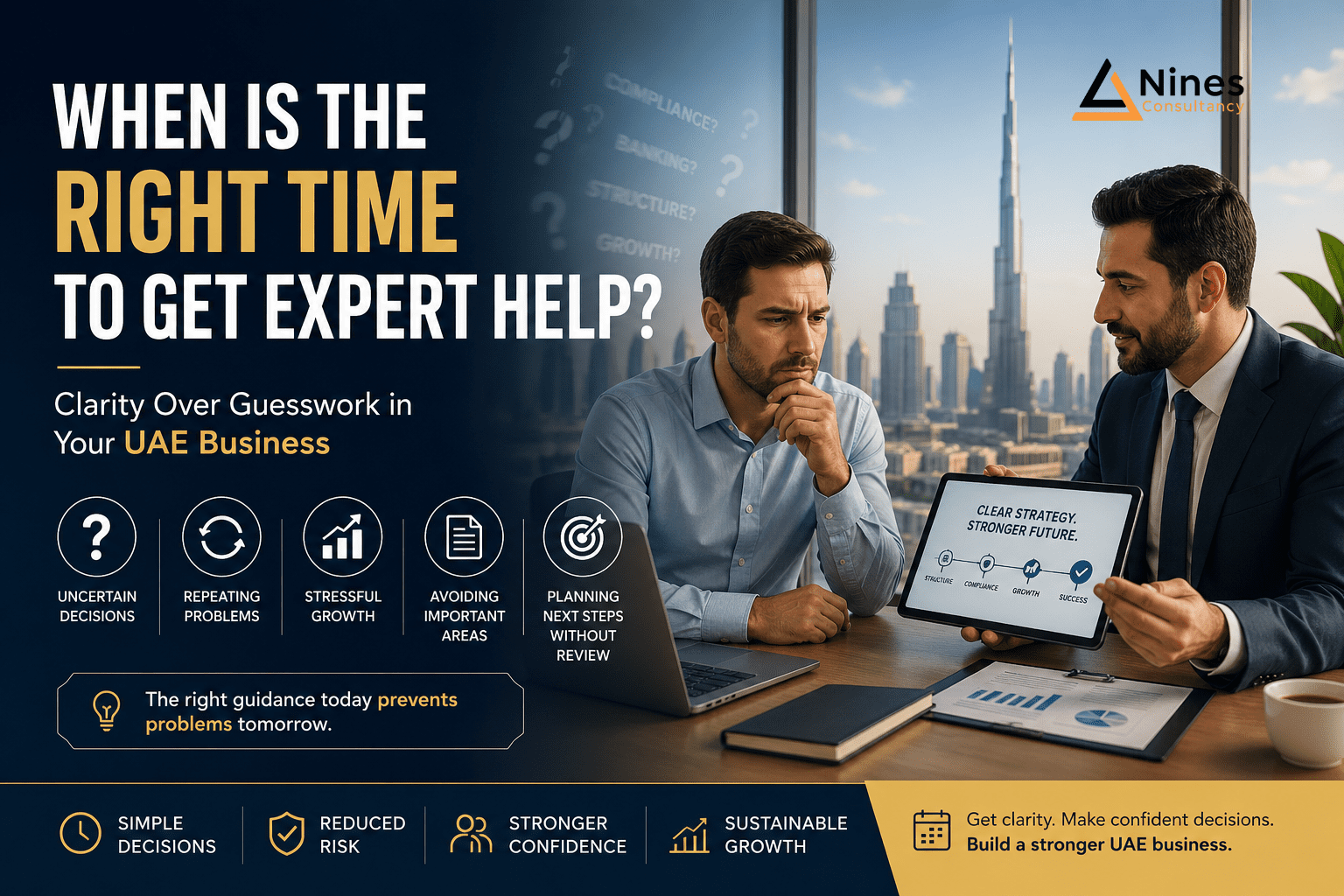
In the UAE’s hyper-competitive ecosystem, the “Founder’s Paradox” is a common phenomenon: the very self reliance that builds a company often becomes the ceiling that prevents it from scaling. Most entrepreneurs launch their ventures with a “do it yourself” ethos, driven by the belief that total independence equals total control. They view the early years as a trial by fire, where the goal is simply to see how far they can go on their own.
However, as the business matures and the regulatory landscape grows more complex, that independence can transform into a trap. There inevitably comes a strategic inflection point where the ability to make clear, informed decisions becomes exponentially more valuable than the ability to execute every task personally. Transitioning from a DIY founder to a strategic leader requires a shift in perspective, recognizing that the path forward demands clarity over solo effort.
It’s About Signals, Not Size
A persistent myth in the UAE market suggests that expert consultancy is a luxury reserved for multinational corporations or late stage enterprises. Many founders mistakenly wait for an arbitrary revenue milestone or a specific headcount before seeking external guidance, treating professional support as a “reward” for success rather than a tool to achieve it.
In reality, the need for professional guidance is not dictated by the size of the balance sheet, but by the operational health and trajectory of the organization. Waiting until the business is “big enough” often results in allowing structural gaps to widen into chasms, creating unnecessary operational debt that is far more expensive to service later.
“In reality, the need for guidance shows up through signals, not size.”
Signal 1: The Danger of “I Think” (Decisions Without Full Clarity)
Operating on assumptions is a high-stakes gamble in an emerging business. When a founder’s vocabulary shifts toward phrases like “This should work… I think,” or “Let’s try this and see,” they are essentially signaling a lack of strategic visibility.
These “educated guesses” often snowball into the primary drivers of first year failure in the UAE. From a consultant’s perspective, these gaps represent a lack of data-driven confidence. Relying on the hope that you can “fix it later” creates a backlog of corrections that eventually paralyzes growth.
“Expert guidance at this stage prevents future corrections.”
Signal 2: The Cycle of Recurring Issues (Repeating Problems)
When the same headaches reappear, be it banking inquiries, documentation confusion, or operational inconsistencies—it is rarely a matter of bad luck. These are symptoms of a deep-seated structural gap.
In the UAE, recurring issues with banking or compliance are particularly dangerous because they signal to external stakeholders that the business lacks internal controls. A strategic leader recognizes that repeating a problem is a sign that the underlying architecture of the business is no longer fit for purpose. Identifying these gaps early is the difference between a sustainable entity and one that constantly operates in “triage mode.”
Signal 3: When Growth Becomes Friction (Stressful Expansion)
Growth is the objective, but there is a profound difference between progress and pressure. Ideally, scaling should feel like momentum, a smoothing out of processes as volume increases. If, instead, expansion brings heightened stress, more manual workarounds, and a sense of mounting confusion, the business structure is misaligned.
Growth without a scalable structure increases friction, which eventually leads to talent burnout, brand damage, and diminished service quality. Expert intervention at this stage is designed to restore momentum by re-engineering the organization to handle the increased load without breaking the founder.
Signal 4: Avoidance as a Red Flag (Delaying the “Difficult” Stuff)
Founders often find themselves subconsciously avoiding certain “opaque” areas, specifically compliance, structure reviews, and banking documentation. This avoidance is a loud signal of uncertainty.
In the UAE, where regulatory shifts can be swift and banking rejections are often final, these unclear areas are the most critical for long term survival. Avoiding them creates a “compliance debt” that can lead to sudden, catastrophic roadblocks. True leadership involves acknowledging that if you are avoiding a specific conversation, that is exactly where you need the most clarity.
Signal 5: The Blind Leap (Planning the Next Step Without Reviewing the Current One)
A common mistake is the “forward only” focus: expanding services, adding partners, or entering new markets without first auditing the current foundation.
Before increasing scale, a strategic leader must know: Is the current structure ready? Will our banking partners support this new activity? Will our compliance obligations shift? Future-proofing your business means ensuring your foundation can support the weight of your ambitions. Without this review, scaling is merely magnifying existing flaws.
The “Wait and See” Fallacy (The Biggest Mistake)
The most frequent and costly mistake founders make is adopting a reactive “wait and see” approach, choosing to delay seeking help until a crisis emerges. This strategy is inherently limiting; by the time a problem manifests as an emergency, your options are depleted and the cost of resolution skyrockets.
Proactive guidance is not about crisis management; it is about maintaining a calm, controlled environment. It allows the founder to remain in the driver’s seat, making decisions from a position of strength rather than desperation.
“The biggest mistake is waiting until: ‘Something goes wrong’ At that point: Options are limited.”
Redefining Expert Help: From Complexity to Clarity
There is a misconception that bringing in experts adds layers of bureaucratic complexity. High-level guidance achieves the exact opposite. Effective support:
- Simplifies decisions by replacing guesswork with factual foundations.
- Clarifies structure to ensure every component of the business serves a strategic purpose.
- Identifies gaps early before they evolve into expensive, public failures.
- Reduces long-term risk by aligning operations with the UAE’s evolving regulatory landscape.
The Clarity Litmus Test
Engaging expert guidance is not an admission of weakness; it is a strategic maneuver to reclaim your time and build confidence. It ensures that as you transition from a hands on founder to the leader of a scalable enterprise, you are building on a foundation of facts.
As you evaluate your operations today, look past your revenue and headcount. Instead, look at the signals. Ask yourself the ultimate litmus test for strategic leadership: “Am I making decisions with full clarity?”
If the answer is no, that is your signal to pivot.
About Nines Consultancy
Nines Consultancy is a premier UAE based business consultancy dedicated to empowering entrepreneurs, startups, and SMEs. We specialize in navigating the complexities of the UAE market through expert company formation (mainland, freezone, and offshore), ISO certification consultancy, VAT and tax compliance, and long term business structuring. Our mission is to transform operational uncertainty into strategic clarity, ensuring your business is built for sustainable growth.