
Starting a business in Dubai is one of the most strategic decisions any entrepreneur can make. With its world class infrastructure, zero personal tax, and investor friendly policies, the Emirate has become a global hub for trade, innovation, and entrepreneurship.
But before you begin your journey, one key question arises: Should you set up your company in a Dubai Mainland or Free Zone?
This decision shapes everything from how you operate and who you can do business with, to your ownership rights, taxation, and expansion opportunities.
Dubai’s business ecosystem offers over 40+ Free Zones, each designed for specific industries such as logistics, media, technology, and finance. On the other hand, Mainland companies, licensed by the Dubai Department of Economy and Tourism (DET, formerly DED), offer unrestricted trading within the UAE market and greater flexibility for scaling operations.
Choosing between the two isn’t just a paperwork decision it’s a strategic choice that defines your company’s reach, structure, and growth potential.
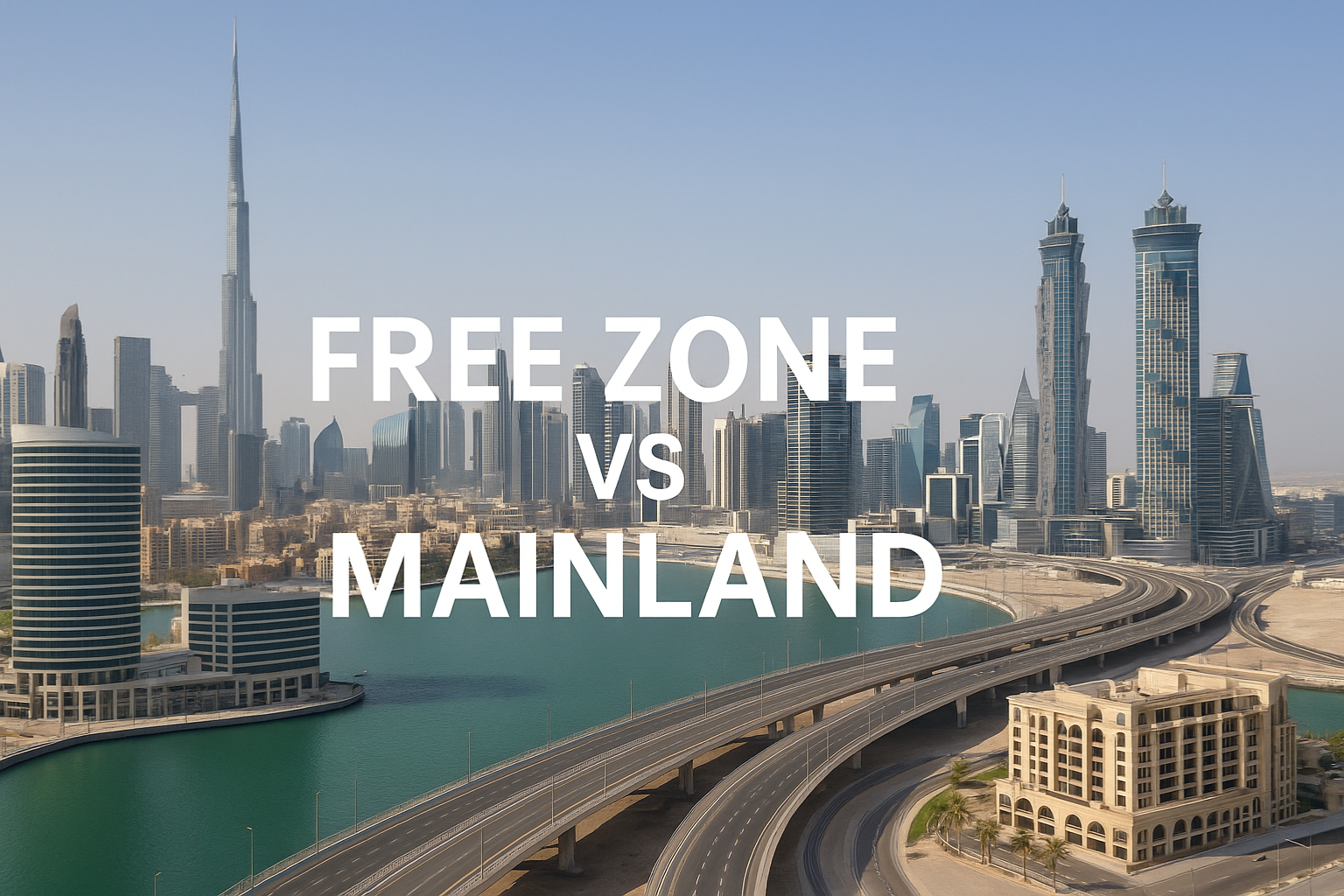
In this comprehensive guide, we’ll break down everything you need to know about Dubai Free Zone vs Mainland company formation, compare their features, highlight their pros and cons, and help you decide which option aligns best with your business goals.
Understanding the Basics
What Is a Mainland Company in Dubai?
A Mainland company (also known as an onshore company) is registered under the Dubai Department of Economy and Tourism (DET). It allows businesses to operate anywhere within the UAE and internationally.
Mainland companies can:
-
Conduct business with UAE mainland clients.
-
Bid for government contracts.
-
Open multiple branches across the UAE.
-
Operate freely without geographical restrictions.
Since 2021, UAE’s foreign ownership reforms now allow 100% foreign ownership in most Mainland business activities, eliminating the need for a local Emirati sponsor in many cases.
What Is a Free Zone Company in Dubai?
A Free Zone company operates within a designated economic area managed by an independent Free Zone Authority. Each Free Zone has its own regulations, tax benefits, and licensing framework designed to attract foreign investors.
Dubai’s most popular Free Zones include:
-
Dubai Multi Commodities Centre (DMCC)
-
Dubai Airport Free Zone (DAFZA)
-
Jebel Ali Free Zone (JAFZA)
-
Dubai Silicon Oasis (DSO)
-
Dubai Internet City (DIC)
Free Zone companies are ideal for businesses focused on international trade, e-commerce, consulting, IT, and media services.
Why This Decision Matters in the UAE Context
The UAE business landscape is diverse, and understanding how each jurisdiction works can directly impact your company’s success.
-
Regulatory Bodies:
Mainland companies are governed by the Dubai Department of Economy and Tourism (DET), while Free Zone entities are regulated by their respective Free Zone Authorities.
-
Market Reach:
Mainland companies can trade within and outside the UAE, while Free Zone companies are restricted from direct trade in the UAE Mainland (unless through a distributor or local agent).
-
Taxation and Compliance:
Both entities benefit from 0% personal income tax. However, corporate tax at 9% applies if your company earns over AED 375,000 annually.
Free Zone companies can often qualify for 0% corporate tax under the UAE’s Qualifying Free Zone Person (QFZP) criteria provided they meet specific conditions and transact mainly outside the UAE.
-
Reputation and Partnerships:
Mainland licenses often carry more credibility for government projects and local partnerships, while Free Zones offer global appeal for tech startups, exporters, and holding companies.
Detailed Comparison: Dubai Free Zone vs Mainland
|
Factor |
Mainland Company |
Free Zone Company |
|---|---|---|
|
Ownership |
100% foreign ownership (for most activities) |
100% foreign ownership |
|
Regulatory Authority |
Dubai Department of Economy and Tourism (DET) |
Individual Free Zone Authority |
|
Business Scope |
Local and international markets |
Mainly outside UAE or within the Free Zone |
|
Office Space |
Physical office required |
Flexi-desk or virtual office allowed |
|
Corporate Tax |
9% (above AED 375,000 profit) |
0% (if qualifying under Free Zone criteria) |
|
Government Contracts |
Allowed |
Not allowed |
|
Repatriation of Profits |
100% |
100% |
|
Import/Export Duties |
5% import duty applies |
Exempt from import/export duties |
|
Visa Eligibility |
Based on office size |
Based on office package and Free Zone rules |
|
Audit Requirement |
Annual audit mandatory |
Varies by Free Zone |
Benefits of Setting Up a Mainland Company in Dubai
-
Unrestricted business activities across the UAE and abroad.
-
Access to government tenders and contracts.
-
Freedom to trade directly with local clients.
-
No currency restrictions or capital repatriation limits.
-
Wide credibility with banks, suppliers, and authorities.
Mainland setups are best suited for:
-
Retail businesses, restaurants, and service providers.
-
Construction, real estate, and contracting firms.
-
Companies dealing directly with UAE-based customers.
Benefits of Setting Up a Free Zone Company in Dubai
-
Full ownership and tax exemptions (up to 50 years in some zones).
-
Quick and cost-effective setup with flexible office options.
-
Simplified customs and import/export processes.
-
No personal income tax and full profit repatriation.
-
Strategic locations near airports, seaports, and logistics hubs.
Free Zones are ideal for:
-
International trading and export businesses.
-
E-commerce and IT companies.
-
Consulting and remote service providers.
-
Startups seeking cost efficiency and global exposure.
Documents Required for Company Formation
Common documents for both Mainland and Free Zone setup include:
-
Passport copies of all shareholders.
-
UAE residence visa or entry stamp (if applicable).
-
Business name reservation and activity approval.
-
Memorandum of Association (MOA) / Articles of Association (AOA).
-
Office lease agreement (Ejari for Mainland / Free Zone office space agreement).
-
Initial approval certificate.
Timeline & Cost Overview
-
Mainland Setup:
Average time 7 to 10 working days.
Cost typically AED 15,000 to AED 30,000+ depending on activity and office space.
-
Free Zone Setup:
Average time 3 to 7 working days.
Cost starting from AED 12,000 to AED 25,000+ depending on the Free Zone and package selected.
Pro Tip:
Choosing the right jurisdiction can save you thousands annually in renewal and compliance costs.
Which Option Is Right for You?
Choose Mainland if:
-
You plan to sell directly to the UAE market.
-
You want to work with the government or semi-government sectors.
-
You need multiple branches across the Emirates.
Choose Free Zone if:
-
Your focus is on international trade, digital services, or e-commerce.
-
You prefer a low-cost, quick setup with full ownership.
-
You don’t need to trade directly within the UAE.
Still unsure? The best decision depends on your business activity, target market, and future expansion goals. That’s where expert consultancy matters.
Why Choose Nines Consultancy
At Nines Consultancy, we simplify the entire company setup process from choosing the right jurisdiction to obtaining your trade license and visas.
Here’s why clients across the UAE trust us:
-
Licensed business setup consultants working directly with UAE authorities.
-
Tailored guidance for Free Zone, Mainland, and Offshore structures.
-
Transparent pricing with no hidden costs.
-
End to end support for trade license, PRO services, and visa processing.
-
Dedicated consultant for personalized assistance.
Book a Free Consultation Today
Call or WhatsApp us to start your business in Dubai with confidence.
Frequently Asked Questions (FAQ)
1. Can a Free Zone company do business in the Dubai Mainland?
Not directly. A Free Zone company must appoint a local distributor or commercial agent to sell products or services in the Mainland market.
2. Do I need a local sponsor for a Mainland company?
No. Since 2021, most business activities in Dubai allow 100% foreign ownership without a local sponsor.
3. Which is cheaper Free Zone or Mainland?
Free Zone setups are generally more cost effective for startups, while Mainland licenses may cost slightly more due to office space and broader trade access.
4. Can I upgrade from Free Zone to Mainland later?
Yes, you can. Many businesses begin in Free Zones and later migrate to Mainland to expand operations within the UAE.
5. Are Free Zone companies subject to UAE corporate tax?
Qualifying Free Zone companies may enjoy 0% corporate tax if they meet conditions under the UAE Corporate Tax Law. Otherwise, the standard 9% rate applies.
Conclusion
Choosing between Dubai Mainland and Free Zone company setup is a decision that shapes your business journey.
If your goal is local trade, flexibility, and government access, the Mainland is ideal.
If you seek cost efficiency, tax benefits, and global reach, a Free Zone setup is the way to go.
At Nines Consultancy, we help you evaluate every factor, from ownership and cost to compliance and future expansion, ensuring you make the smartest, most profitable choice.
Ready to start your UAE business journey?
Book your Free Consultation today or Chat with us on WhatsApp for personalized guidance.