
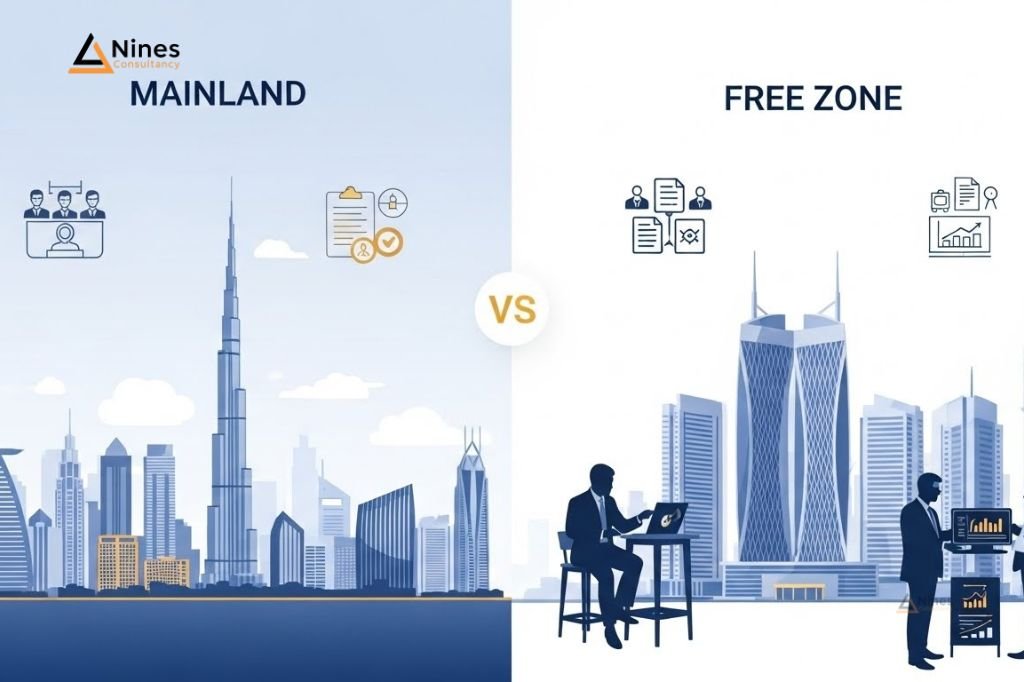
The United Arab Emirates continues to be one of the most attractive business destinations in the world, offering a powerful combination of economic stability, tax efficiency, strategic geography, and investor friendly reforms. As we move into 2026, more entrepreneurs, SMEs, and global brands are choosing to establish operations in Dubai, Abu Dhabi, Sharjah, and the Northern Emirates. Whether you are launching a consultancy, e-commerce store, trading company, or a full scale operation, the first major decision you must make is selecting between a Mainland company or a Free Zone company.
This decision shapes your market reach, regulatory obligations, branding, visa flexibility, and long-term scalability. The UAE offers both options because each serves a different type of business model. Mainland structures are designed for companies that want to operate across the Emirates with no market restrictions, work with government entities, or open retail or service based outlets. Free Zones, on the other hand, offer streamlined, cost effective licensing for entrepreneurs who want full ownership, minimal setup requirements, and a business model that doesn’t require direct Mainland operations.
Understanding the difference between these two routes is critical because choosing incorrectly can slow your growth, increase operational costs, or limit your ability to expand. In this comprehensive 2026 guide, we break down everything you need to know in simple, practical terms. We reference real UAE authorities and systems such as the Department of Economic Development (DED), the Ministry of Human Resources and Emiratisation (MOHRE), and the Federal Tax Authority (FTA) so you gain clarity based on actual market rules and not assumptions.
What Is a Mainland Company?
A Mainland company is registered with the Department of Economic Development of a specific Emirate. For example:
- Dubai Mainland licensing is issued by Dubai DED.
- Abu Dhabi Mainland licensing is issued by ADDED.
- Sharjah Mainland licensing comes from SEDD.
Mainland companies are free to operate across the entire UAE, making them the preferred choice for businesses that want to access the local market directly. After the UAE introduced 100 percent foreign ownership for most commercial and professional activities, Mainland structures have become even more attractive for expatriates.
Key Features
- Operate freely anywhere in the UAE.
- Access to Mainland clients, government entities, and corporate contracts.
- Flexibility in opening multiple branches across different Emirates.
- Higher visa quotas depending on office size and business activity.
- Strong reputation among local consumers and B2B clients.
Mainland structures are essential for businesses like restaurants, retail outlets, contracting companies, logistics firms, real estate brokerages, marketing agencies serving UAE clients, salons, gyms, and other on ground operations.
What Is a Free Zone Company?
A Free Zone company is formed within a designated economic zone such as IFZA, DMCC, RAKEZ, SHAMS, Meydan FZ, SAIF Zone, Ajman Free Zone, Dubai South, or ADGM.
Free Zones were created to support specific industries like technology, trading, media, logistics, and professional services. They offer full foreign ownership, simplified compliance requirements, and cost effective packages, making them popular among startups and global entrepreneurs.
Key Features
- 100 percent foreign ownership for all business types.
- No UAE national involvement required.
- Ideal for international operations and e-commerce.
- Flexi desk or virtual office options available.
- Quick licensing and easy onboarding process.
- Simplified visa and employment structure.
Free Zones are perfect for consultants, freelancers, trading companies, digital businesses, import/export companies, holding companies, and entrepreneurs who prioritize global trade over local physical operations.
Why This Decision Matters in the UAE Context
Choosing between Mainland and Free Zone is not just a licensing preference. It directly affects compliance with UAE authorities and your ability to operate legally. For example:
DED Market Access Rules
DED licensing allows unrestricted trade within the Emirate and across the UAE. Free Zone companies are restricted from selling directly in mainland UAE without a distributor or branch.
FTA Tax Requirements
Both Mainland and Free Zone companies fall under Federal Tax Authority rules for Corporate Tax and VAT. However, the tax implications can differ depending on:
- Whether your Free Zone qualifies as a tax exempt Free Zone Person under Corporate Tax.
- Where you conduct your business activities.
- Whether your business is considered Mainland-sourced.
MOHRE Employment Rules
Mainland companies use MOHRE quotas for visas, while Free Zones manage their own systems.
Banking Compliance
Bank account opening varies based on risk category, business model, and Emirates-based regulations. Mainland companies often have broader acceptance for corporate accounts due to their perceived credibility and wider market operations.
Understanding these layers ensures your decision aligns with long-term growth and regulatory compliance. This is exactly why many entrepreneurs rely on professional consultancy like Nines Consultancy to avoid costly mistakes.
Mainland vs Free Zone, Detailed Comparison
Market Access
Mainland companies can operate freely across all Emirates.
Free Zone companies can operate within their zone and internationally. To sell inside the UAE Mainland, they must appoint a distributor or open a branch.
Ownership Rules
Both Mainland and Free Zone companies allow 100 percent foreign ownership for most commercial and professional activities as of 2024 onward.
Office Requirements
Mainland licensing requires a physical office or shared workspace.
Free Zones allow flexi desk options, virtual offices in some zones, or physical offices depending on business activity.
Client Base
Mainland companies can sell to both government and private sector clients.
Free Zone companies cannot work directly with government entities unless they open a Mainland branch.
Visas and Staffing
Mainland companies have higher flexibility.
Free Zone visa packages depend on the specific zone and facility type.
Reputation and Local Trust
Many UAE clients prefer working with Mainland companies because of location credibility and direct accessibility.
Step by Step Process for Mainland and Free Zone Setup
How to Set Up a Mainland Company in the UAE
Step 1: Choose Your Business Activity
Your activity determines approvals, office requirements, and compliance steps. Mainland licensing offers hundreds of activities under DED.
Step 2:Select Legal Structure
Common structures include:
- Sole Establishment
- Civil Company
- Limited Liability Company (LLC)
Step 3: Trade Name Reservation
You must choose a name that complies with UAE naming guidelines.
Step 4: Initial Approval
DED issues initial approval allowing you to proceed with documentation and agreements.
Step 5: Office or Workspace Setup
Every Mainland company must secure a physical address.
Step 6: Apply for Government Approvals
Depending on your activity, you may require additional approvals such as:
- Dubai Municipality
- Food Safety Department
- Dubai Tourism (DTM)
- Civil Defense
- RAK Tourism
- Ministry of Health
Step 7: Final License Issuance
Once all documents are approved, DED issues the business license.
How to Set Up a Free Zone Company in the UAE
Step 1: Choose the Free Zone
Each zone caters to different industries.
For example:
- IFZA for general trading and consulting
- DMCC for commodities and finance
- RAKEZ for industrial licenses
- SHAMS for digital media
- ADGM for financial services
Step 2: Select Business Activity
Free Zones provide predefined activity lists that must be matched accurately.
Step 3: Submit Application and Documents
Most zones allow digital onboarding, making this step extremely easy.
Step 4: Flexi desk or Office Allocation
Choose between flexi desk, service office, or warehouse depending on your business.
Step 5: License Issuance
Free Zones typically have faster turnaround times.
Step 6: Visa Processing
The number of visas depends on your package or office space.
Documents Required
Common documents include:
- Passport copy
- Visa or entry permit
- Passport sized photo
- Contact details
- Business activity list
- Trade name options
Some activities may require additional documentation. Nines Consultancy handles all documentation and approvals end to end.
Cost and Timeline
Costs depend on activity, Emirate, and required approvals.
Timelines vary between Mainland and Free Zone systems.
For accurate and updated information, Nines Consultancy provides a consultation tailored to your business structure.
Why Choose Nines Consultancy
Business setup in the UAE involves multiple layers of approvals, documentation, and compliance steps. Nines Consultancy ensures you get everything right from day one.
Our Advantages
- UAE business setup experts with multi Emirate knowledge.
- Strong network with DED, Free Zones, MOHRE, and FTA.
- Transparent process with no hidden fees.
- End to end support including licensing, visas, PRO services, and bank account assistance.
- ISO certified consultancy approach for accuracy and compliance.
- Dedicated advisors to guide you from planning to launch.
Chat with our experts on WhatsApp for free consultation:
+971 52 975 7543
Or call us directly at:
+971 52 975 7543
FAQs
1. Which is better for my business, Mainland or Free Zone?
It depends on your business model. If you want to sell in the UAE or open a physical location, Mainland is better. If your business operates internationally, a Free Zone may be ideal.
2. Can Free Zone companies operate in Mainland UAE?
Yes, but only through a Mainland branch, distributor, or service agent.
3. Do I get 100 percent ownership in Mainland companies?
Yes, for most activities. The UAE allows full foreign ownership across a wide range of commercial and professional activities.
4. Which option offers more visas?
Mainland companies usually have higher visa quotas, depending on office size.
5. Which structure is easier for banking?
Both can open UAE bank accounts, but Mainland companies may have stronger acceptance due to broader market access.
6. Do both structures require Corporate Tax registration?
Yes, both fall under the Federal Tax Authority unless exempt under Cabinet rules.
Start Your UAE Business with Confidence
Choosing between Mainland and Free Zone is one of the most important strategic steps when expanding into the UAE. Both options offer powerful opportunities, but the right choice depends on your business model, market goals, and long-term vision. With the UAE’s 2026 reforms prioritizing foreign investment, now is the perfect time to establish your presence and scale confidently.
Nines Consultancy guides you through every step, ensuring you choose the structure that matches your goals and remains fully compliant with UAE regulations. From business licensing and PRO services to VAT consultancy and bank account setup, we help you build a solid foundation for sustainable growth.
Chat with us today for free consultation:
+971529757543
Or call/WhatsApp: +971 52 975 7543
Your UAE business begins here.